Google Doesn’t Rank Website Design: Why Code, Structure, and Performance Matter
Have you ever wondered why some of the best-looking websites you see are nowhere to be found on Google? You...
Have you ever wondered why some of the best-looking websites you see are nowhere to be found on Google? You...
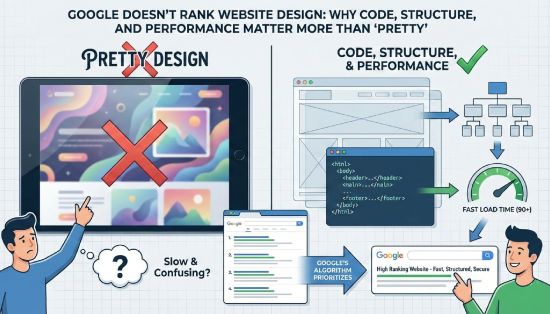
Have you ever wondered why some of the best-looking websites you see are nowhere to be found on Google?
You search for a service, and the top results are often simple, fast, and straight to the point. Meanwhile, that stunning website with the flying animations and high-resolution videos is buried on page 10.
It is a hard truth to accept, especially after you have spent thousands on a design, but Google does not rank design.
Google is a robot. It cannot “see” beauty. It reads code. It measures speed. It analyzes structure.
If you are a business owner, this distinction is the difference between having a digital brochure that nobody sees and a business asset that generates money. As a website developer in Dubai , I have seen this pattern repeat itself over and over again.
In this guide, we are going to break down exactly why 87% of websites fail to perform and why you need to stop hiring designers to do a developer’s job.
In 2024, I started auditing websites deeply. I wanted to understand why so many businesses were struggling to get leads despite having “professional” looking sites.
I reviewed over 100 businesses. The results were shocking.
I saw beautifully designed websites sitting on page 10 of Google, completely invisible to real customers. These business owners were frustrated. They thought that because their website looked good to them, it should look good to Google.
But here is the reality: 87% of websites fail.
They fail not because they are ugly, but because they are broken on the inside. When you focus only on the visuals, you often ignore the engine that drives the car. You wouldn’t buy a Ferrari that has a lawnmower engine inside, right? But that is exactly what many businesses do with their websites.
I recently conducted a 1000 sites review, and the data confirmed one thing: The websites that win are the ones that are built for machines first, and humans second.
If you feel like your website isn’t bringing you any business, it is likely due to one of these three reasons. These are the most common traps business owners fall into.
Most websites today are built on generic templates. You buy a theme for $50, drag and drop some pictures, and hit publish.
The problem? They all look the same.
Google is looking for “Unique Value.” If your website’s code looks exactly like 10,000 other websites because you used the same template, Google has no reason to prioritize you. Templates are often bloated with unnecessary code that you don’t even use, which confuses search engines.
When we discuss template vs custom coded solutions, the difference is clear. A custom solution is built for your specific needs, while a template is a “one-size-fits-all” shirt that doesn’t really fit anyone perfectly.
We all love high-quality images and cool animations. But usually, performance is compromised for pretty images.
When you upload a massive photo to your homepage without optimizing it, you are killing your loading speed.
It doesn’t matter how nice the photo is if nobody waits around long enough to see it.
This is the most critical point. Businesses hire designers instead of developers.
A designer is an artist. They understand colors, spacing, and typography.
A developer is an architect and an engineer. They understand logic, server response times, and database structures.
When you hire a designer to build a website, Google’s guidelines are often ignored because the website is designed, not developed. A website designer usually does not understand technical details, tricky coding, or Google’s strict guidelines. They make it look good, but they don’t know how to make it work.
If Google doesn’t care about your color scheme, what does it care about?
Google ranks Structure, Performance, Code Quality, and Unique Value.
Imagine your website is a book.
Google needs a clean structure (Sitemaps, Headings, Schema Markup) to understand what your business does. If your structure is messy, Google’s bots get lost and leave.
Google has a specific set of metrics called “Core Web Vitals.” These measure:
If you fail these tests, your rankings drop. It is that simple.
Clean code is easy for Google to read.
Messy code (often found in drag-and-drop builders) takes longer to process.
To understand this deeply, you need to look at how should a website be develop from the ground up. Real development involves writing code that is efficient, secure, and lightweight.
I am not just another web designer selling services. I am a software developer who codes real systems.
There is a massive difference in mindset.
I deeply understand business and I architect websites that are built for growth. This means starting with the foundation.
This approach turns your website from a digital brochure into a powerful tool. My websites are fast loading, optimized for all devices, technically strong, and built to grow authority with Google and trust with users.
Q: Does design not matter at all?
A: Design matters for humans. It builds trust once they are on the site. But code matters for Google. You need good code to get the user to the site, and good design to keep them there. You cannot have one without the other, but code must come first for ranking.
Q: Why is my template website so slow?
A: Templates are built to sell to thousands of people. They include every possible feature (sliders, popups, galleries) just in case you might need them. All that extra code loads every time a user visits, even if you aren’t using those features. This “code bloat” kills speed.
Q: Can I fix my existing website, or do I need a new one?
A: Sometimes we can clean up code, but if the foundation is rotten (like a bad template), it is often cheaper and more effective to rebuild it properly. It is like trying to fix a house with a broken foundation—sometimes you have to start fresh.
Q: How do I know if my developer knows technical SEO?
A: Ask them about “Core Web Vitals,” “Schema Markup,” and “Server-Side Rendering.” If they look confused or only talk about colors and logos, they are designers, not technical developers.
Q: What is the difference between a “Digital Brochure” and a “Business Asset”?
A: A brochure sits there and looks pretty. It costs you money to host. A business asset works for you 24/7, ranks on Google, brings in leads, and makes you money.
Stop letting your beautiful website sit in the dark on page 10.
The reason 87% of websites fail is that businesses prioritize the wrong things. They choose generic templates over custom code, pretty images over performance, and designers over developers.
Remember these key takeaways:
I analyze the business, research the market, identify gaps, and design a digital strategy. Then, I develop a website as a business asset.
If you are ready to stop playing games and start ranking, contact me so I can explain this clearly with live examples. Let’s build something great together and take your business to the next level.
Here are some extra tools and links to help you understand the technical side of what we discussed.