AI Hype vs Reality shock Web Design and development Dubai
Learn the real facts about web design and development in Dubai. See why AI chatbots fail to convert, the truth about GEO, and what actually builds sales.
Learn the real facts about web design and development in Dubai. See why AI chatbots fail to convert, the truth about GEO, and what actually builds sales.
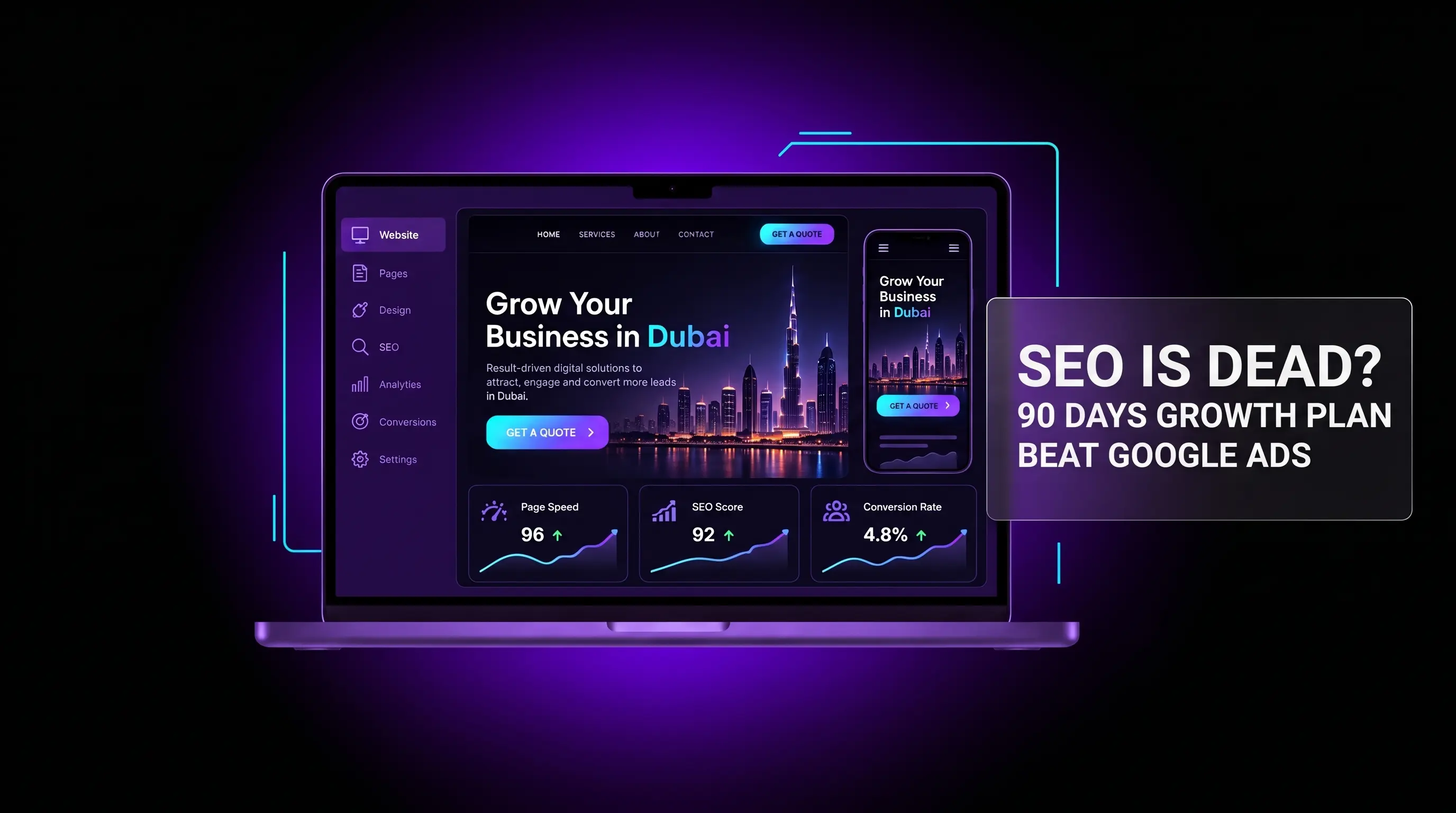
Early in the third decade of the 21st century, the artificial intelligence boom has reached peak momentum. The hype is everywhere. It leaves business owners and new founders questioning their basic digital strategy. In a high-velocity market like Dubai, an effective web presence is a commercial necessity. Yet, aggressive sales pitches claim standard sites are obsolete. Agencies insist that every brand must now run an "AI-powered website," that SEO is being replaced by GEO, and that reliable chat software like Tawk.to is made to sound completely outdated by the hype around automated bots. Dubai is positioned at the forefront of global tech adoption. Because of this, many businesses are adopting these tools without analyzing the reality behind them.
This analysis takes a factual, micro-level look at what is actually happening in the market. We break down why current market forecasts mirror the late 1990s dot-com bubble, examine real conversion data showing why AI WhatsApp bots fail to close leads, dissect why GEO is an empty concept while SEO remains the foundation of discovery, and review recent admissions from OpenAI CEO Sam Altman alongside the economics behind Sora's API shutdown. Finally, we provide a clear, practical roadmap for businesses investing in web design and development in Dubai.
A market with an actual capacity of 100 cannot be projected for 1,000. Yet, this cycle repeats roughly every decade whenever transformative technology enters the mainstream.
In the late 1990s, the internet was a genuine revolution. The dot-com crash occurred not because the technology was useless, but because adoption timelines and revenue projections were wildly exaggerated. The modern AI boom shows identical symptoms. The underlying tools are powerful, but their near-term commercial application has been inflated far past what the market can actually support.
Not every business requires artificial intelligence, and not every website benefits from a chatbot. Large language models introduce severe hallucination risks, invent details under pressure, and actively erode consumer trust the moment users realize they are speaking to an automated system instead of a human representative.
Early in 2025, many service providers rushed to turn their API-based WhatsApp Business channels into natural-language AI sales agents. On paper, combining WhatsApp's direct reach with conversational models looked like an effortless way to scale operations. In practice, early adopters saw customer satisfaction drop.
By 2026, when Meta introduced free built-in AI agents inside WhatsApp Business, the operational risks became impossible to ignore. These bots routinely invent policies, hallucinate pricing structures, and respond on behalf of a company with inaccurate details that kill qualified leads. More critically, when a paying customer initiates a direct conversation and encounters a bot, engagement collapses.
At Onlinetist, we tracked this firsthand. We integrated an AI agent into our own WhatsApp channel to test its commercial viability; within thirty days, the automated system cost us two qualified enterprise clients. We continued the experiment using Meta's built-in business AI agent, and the pattern held: prospective clients consistently disengaged after just two or three messages. For high-value transactions, automated bots create friction where personal trust is required.
In September 2025, Onlinetist published a detailed teardown titled "GEO vs SEO: The Digital Lie You Are Sold Something That Does Not Exist." This was before Google rolled out its AI modes across standard desktop and mobile browsers, during a period when agencies claimed organic search was obsolete in favor of Generative Engine Optimization (GEO).
The premise of GEO falls apart under basic technical inspection. AI does not bypass search engines; AI requires search engine indexes to retrieve live, verifiable information. If an AI platform ever replaces Google search, it will be Google's own internal architecture doing so.
AI systems surface web data through two distinct mechanisms:
Every established marketing discipline has a concrete technical workflow. SEO has a rigorous, measurable process: crawl budget management, structured data, core performance metrics, and topical authority. What technical workflow does GEO offer? Uploading an llm.txt file and adding basic Q&A blocks to a page? That is not an optimization process. AI search engines retrieve and cite websites without an llm.txt file because RAG relies entirely on organic search visibility, which is established exclusively through traditional SEO.
Artificial intelligence produces tangible return on investment inside enterprise ecosystems handling massive transaction volumes. Giants like Amazon, TikTok, Meta, and Google have already deployed machine learning across ad delivery networks, behavioral targeting, and ranking algorithms. Enterprise platforms like HubSpot and Monday.com already feature native AI automation built directly into their software stacks.
Local enterprises such as neighborhood supermarkets, salons, or clinics—have no use for custom AI workflows. The practical automations they actually require already exist inside their everyday business software, making custom-built site AI an unnecessary capital expense.
The financial reality of running high-compute models is forcing the industry to recalibrate. OpenAI CEO Sam Altman, who originally suggested that AI would replace 30% to 40% of the workforce across multiple sectors, has since moderated that claim. The industry consensus is now far more grounded: AI will not replace human workers; rather, professionals who leverage AI effectively will outcompete those who do not.
The operational overhead behind consumer generative tools is proving difficult to sustain. OpenAI's video generation engine, Sora, had its developer API halted in September 2026. While Sora generated approximately $1.2 million USD in total revenue, its daily server infrastructure costs ran at roughly $2 million USD per day.
When operating expenses outpace revenue at that scale, capital projections collapse. To survive, the market is shifting toward architectural efficiency, model distillation, and quantization to deploy smaller, viable models at sustainable margins. Bulky, high-cost platforms will either streamline or close, while lean, specialized alternatives (such as tools like Toon Bee) continue to challenge expensive providers.
Artificial intelligence delivers legitimate commercial value when applied as an internal efficiency multiplier for skilled professionals:
AI operates best as a back-office tool that accelerates production for professionals who already understand how to execute the work without it.
Forget about chasing AI additions and forget about trying to optimize for GEO. GEO has nothing to do with your daily business, and it is not something you configure with a magic plugin. GEO is something that happens automatically on top of solid SEO once your site is visible. Not every business needs AI slapped onto its homepage.
Instead of looking for shortcuts, businesses in Dubai need to focus on building a website the right way from day one.
Many business owners make the mistake of using heavy pre-made templates or relying on "AI website builders" that generate thousands of lines of bloated, useless code. This extra junk slows down your server, hurts mobile usability, and ruins your chances of ranking. What actually drives business growth is a clean, custom-coded website that is lightweight, built with clean on-page SEO from the very first line of code, and heavily optimized for pure loading speed.
Beyond clean code, how you write the content on your website makes or breaks your conversions:
However, executing this requires very strategic thinking when planning your website copy. SEO in 2026 is not the same as it used to be. Today, organic Google search results are heavily taken over by Google Ads, which makes ranking organically trickier and turns direct landing page conversion into a critical business puzzle.
No. Local consumers prefer direct, reliable answers. Automated language bots regularly hallucinate, misstate terms, and introduce friction into the sales funnel, leading to higher bounce rates and abandoned inquiries.
GEO lacks an independent technical framework. AI engines surface live web results via Retrieval-Augmented Generation (RAG), which pulls directly from standard search engine indexes. Without high-quality technical SEO, an AI engine has no way to locate or cite a business.
Sora faced severe infrastructure imbalances. The platform generated approximately $1.2 million USD in total revenue while consuming an estimated $2 million USD per day in server and compute overhead, proving that unsustainable operating costs eventually force tools to pull back.
While early claims suggested widespread direct replacement of standard jobs, OpenAI CEO Sam Altman and other industry figures have clarified that AI acts as an efficiency amplifier: AI will not outright replace people, but professionals who utilize AI effectively will replace those who fail to adopt it.
Technical SEO governs site architecture, database calls, asset loading, mobile rendering, and semantic structure. Attempting to add SEO to an improperly coded site requires rebuilding core templates, inflating development costs and delaying time to market.
The artificial intelligence boom offers clear internal productivity advantages, but treating AI as a replacement for proven website development fundamentals is a costly mistake. Much like the late 1990s dot-com bubble, industry valuations have outpaced near-term operational realities.
From failed WhatsApp bots that erode customer trust to heavy platforms like Sora struggling under multimillion-dollar daily compute bills, unmonitored AI carries real business risk. For companies in Dubai, sustainable revenue is built on clean code, rapid mobile speeds, direct human communication, and search optimization built into the foundation of the site.