Template vs Coded Website: Why Bloated Template or DIY Is a Future Risk
Does every business need an expensive custom-coded website from scratch, or are pre-made WordPress themes really the enemy? In this guide, we break down why code bloat destroys mobile speed, why closed site builders lock you in, and how hand-coded pre-built architecture delivers 90+ speeds at an affordable cost.
02 Nov 2026
Kaleemullah Naik
When business owners in the UAE set out to build a website, they usually get pushed into two extreme corners. On one side, digital agencies pitch expensive custom software solutions costing tens of thousands of dirhams, claiming anything less will fail. On the other side, cheap freelancers offer fifty-dollar pre-made themes that look decent in screenshots but end up breaking within three months. For small to medium-sized businesses trying to scale, neither option makes sense. You cannot justify spending a massive budget on experimental custom code, but you also cannot afford a slow, broken site that ruins your search engine rankings.
Choosing the right approach for web design and development in Dubai should not force you to pick between burning your operational capital or buying bloated digital junk.
This blog breaks down the technical reality behind the template versus custom code debate. We examine why WordPress itself is not the problem, look at the anatomy of why popular page builders destroy mobile loading speed, review the hidden costs of locked-in site builders like Wix and Shopify, share verified Google PageSpeed Insights data from a real 50-page WordPress project, and introduce the third option that gives businesses speed, full ownership, and affordability.
The Real Myth: Is WordPress or the Template to Blame?
Whenever a commercial website performs poorly, loads slowly, or drops off Google search results, people tend to point fingers at the wrong targets:
Is WordPress bad? No. WordPress powers over 40% of the internet. It is an open-source, highly capable content management system.
Is using a template bad? No. Having a structured visual layout and pre-planned user flow is standard practice across digital design.
Does every small business need a fully custom-coded platform from scratch? Absolutely not. If you run a transport company, a clinic, or a corporate consultancy, you do not need an agency to spend six months inventing a new wheel.
The real enemy of online performance is not WordPress, and it is not the concept of a template. The real enemy is code bloat.
Anatomy of a Bloated Website: Why Page Builders Fail on Mobile
The reason so many business websites fail Core Web Vitals comes down to how commercial themes and visual page builders are structured.
Imagine a typical business website built with popular drag-and-drop page builders like Elementor or WPBakery. Your site might only need ten to fifteen basic functional blocks: a clean header, a hero banner, some service columns, an inquiry form, and a footer.
However, to sell that theme to thousands of different buyers, the theme developer bundles everything imaginable into one package:
Hundreds of Unused Widgets: Even if you only use five basic text blocks, the page builder still loads the underlying JavaScript and CSS files for all one hundred widgets across every page.
Multiple Bundled Demos: Many commercial themes store files for twenty different industry demos directly on your server, cluttering your database and file directories.
The "Plugin for Everything" Syndrome: Need an inquiry form? Install a plugin. Need a photo gallery? Install another plugin. Need WhatsApp chat, a booking calendar, or customer reviews? Add three more.
Before long, a simple corporate website is running fifteen to twenty active plugins. Every single plugin adds its own separate database queries, CSS files, and JavaScript assets.
The result is unavoidable: there is practically not a single WordPress site anywhere in the world running fifteen heavy plugins and a commercial drag-and-drop page builder that scores above 90 on Google PageSpeed Insights on a mobile device. The browser simply cannot process that much unoptimized junk on a smartphone.
The "Closed Wall" Rental Trap: Wix, GoDaddy, and Shopify
To avoid technical maintenance, many business owners turn to closed website builders like Wix, GoDaddyWebsite Builder, or Shopify for basic service websites.
While these platforms market themselves as simple DIY alternatives, they introduce a different set of problems:
You Own Nothing: You do not own your source code, you do not own the backend database, and you cannot move your website to a faster, cheaper hosting provider if you are unhappy. You are renting digital real estate.
Locked-In Code Bloat: You cannot remove the heavy underlying framework scripts that these platforms inject into your pages. If a third-party script makes your site fail mobile Core Web Vitals, you have zero power to optimize or recode it.
The Compounding Expense: Between monthly platform fees, mandatory app store subscriptions, and transaction surcharges, a year or two of running on these platforms easily equals or exceeds the cost of purchasing a permanent, professionally engineered asset.
Trading away technical ownership for an easy setup is an expensive compromise that limits how far your website can grow.
The Proof: Rihan Bus Rental Case Study
To prove that WordPress is not the problem and that clean code changes everything, consider a real project: Rihan Bus Rental.
This is not a tiny, one-page brochure website. It is an active commercial transport platform operating in the UAE with:
Over 50 indexed service, fleet, and operational pages
Custom product and fleet vehicle listings
Dedicated category archives
Direct WhatsApp inquiry routing
Large, high-resolution media galleries across all vehicle fleets
Despite running over fifty content-heavy pages on a standard, cost-effective shared hosting server, the platform achieves remarkable performance benchmarks:
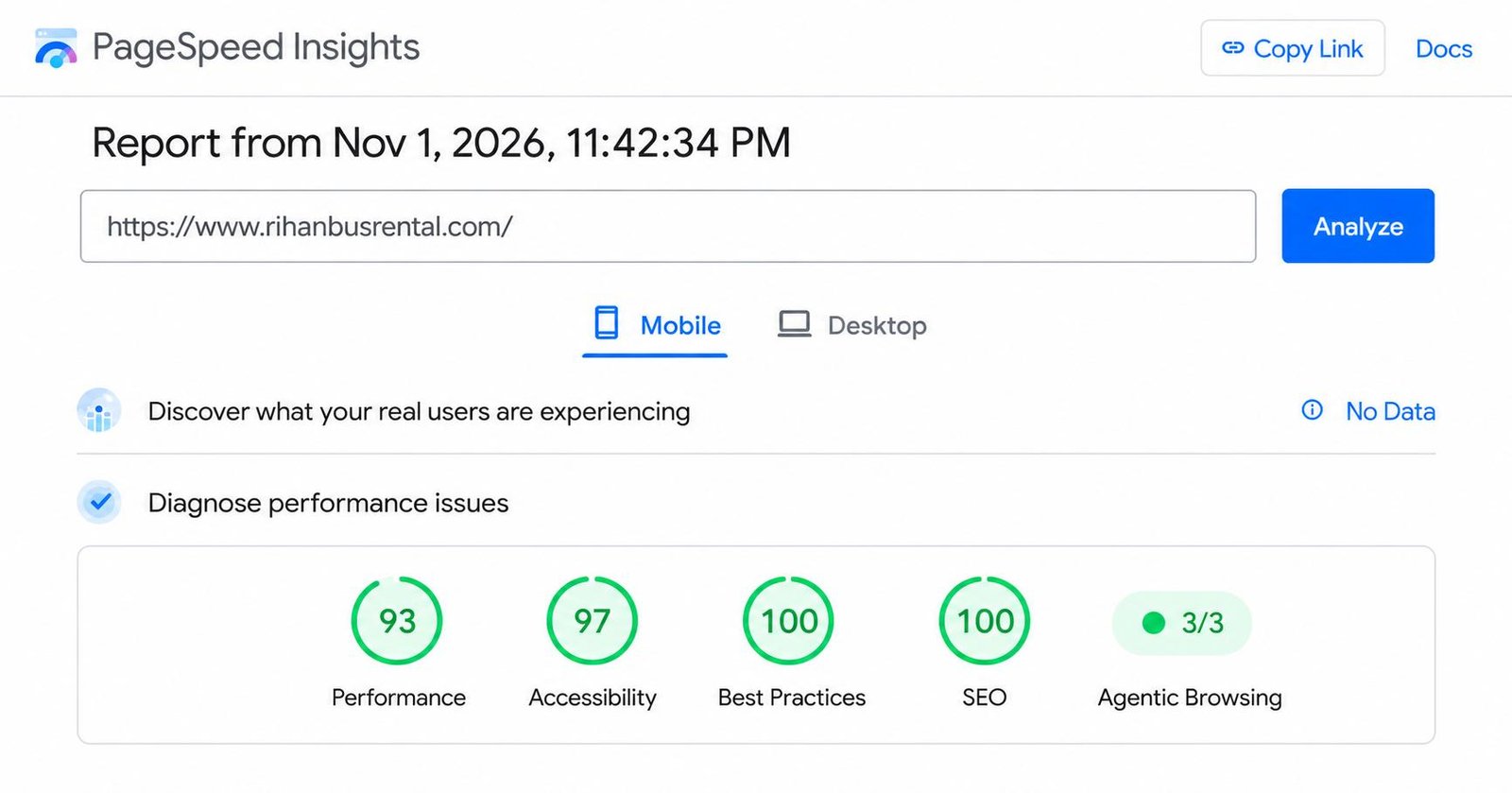
Mobile Google PageSpeed Insights Score: 93 / 100
SEO Technical Audit Score: 100 / 100
Anyone can run this URL through Google PageSpeed Insights—Google’s official, free diagnostic tool—and verify these numbers directly.
Mobile Speed Score: 93 / 100 on Google PageSpeed Insights
Technical SEO Score: 100 / 100
Visual Page Builders Used: Zero (built completely without Elementor or WPBakery)
Why Does This Site Perform While Others Fail?
The difference comes down to execution:
The site uses WordPress strictly as a lightweight database and content engine, pairing it with Advanced Custom Fields (ACF) so the business can edit text and images easily.
It was built with clean, handwritten code rather than an off-the-shelf commercial theme.
It contains zero bloated page-builder frameworks, zero unused widget scripts, and zero multi-demo clutter.
The frontend requests only the exact CSS and JavaScript required to render the specific page being viewed.
Clean code on a standard server consistently outperforms bloated themes hosted on expensive cloud instances.
Custom Coded vs. Hand-Coded: Understanding the Difference
Clarifying this distinction is critical for business planning.
When agencies talk about "custom-coded platforms," they should be referring to bespoke software architecture: custom SaaS dashboards, multi-vendor marketplaces, internal ERPs, or specialized booking engines where off-the-shelf software genuinely cannot fulfill the operational workflow. For these specialized use cases, building from scratch is necessary, and the higher investment makes commercial sense.
However, for standard commercial websites—companies that need to show their services, present case studies, build organic search authority, and capture leads—spending enterprise budgets on custom software from scratch is an unnecessary expense.
You do not need custom software architecture. What you need is a hand-coded foundation.
The Third Way: Hand-Coded Pre-Built Architecture
To solve this dilemma, Onlinetist developed a practical middle ground: The Third Way.
Instead of forcing clients to choose between an expensive, ground-up custom build or a bloated fifty-dollar theme, we engineered a catalog of over 40 pre-built affordable website designs
The critical difference is how these designs are constructed:
Engineered with Clean Code: None of them use drag-and-drop page builders, unoptimized themes, or heavy third-party plugins. Every line of HTML, CSS, and lightweight JavaScript is cleanly written by hand.
Guaranteed Mobile Performance: Because there is zero code bloat, these architectures naturally achieve 90+ mobile speeds on Google PageSpeed Insights right out of the box.
Full Digital Ownership: The site runs on your own hosting account. You own 100% of the code, content, and database with zero recurring vendor lock-in.
Affordable Investment: Because the structural layout is already built, businesses get the speed, search optimization, and security of an enterprise coded site at an accessible price point.
This approach gives growing businesses a dependable, high-converting digital platform without draining cash reserves on custom engineering they do not need.
Frequently Asked Questions
Why does a slow WordPress site hurt our Google rankings?
Google evaluates user experience directly through Core Web Vitals, prioritizing metrics like Largest Contentful Paint (LCP) and Cumulative Layout Shift (CLS). When a bloated theme takes five seconds to load on a mobile device, Google demotes the site in search results in favor of faster, cleaner competitors.
What makes Advanced Custom Fields (ACF) better than page builders?
Visual page builders load massive libraries of unneeded scripts to give drag-and-drop convenience. ACF attaches simple, lightweight input fields directly to clean code templates, allowing you to edit text, swap images, and add pages without injecting any performance-killing code into your frontend.
Can a hand-coded WordPress site still be edited by non-technical staff?
Yes. Hand-coded does not mean you have to write code to update your website. The backend dashboard is configured with simple input boxes for your headings, text, and images. Your internal team can update the site easily without the risk of accidentally breaking the page layout.
Why not just build a service website on Shopify or Wix?
Shopify is an excellent platform for dedicated eCommerce, but for service businesses, both Shopify and Wix lock you into recurring monthly subscription fees and proprietary ecosystems. You cannot export your code, you cannot remove built-in platform scripts, and you have limited control over technical search engine optimization.
How do I verify if my current website is bloated?
Visit Google PageSpeed Insights (web.dev/pagespeed), enter your website URL, and review your mobile performance tab. If your score sits in the red or low orange zone (below 70), your site is suffering from script bloat, unoptimized styles, or slow server response times that require attention.
Summary
The idea that businesses must choose between an expensive custom-coded build or a sluggish, pre-made template is a false choice. WordPress remains an exceptional platform, but pairing it with visual drag-and-drop builders and twenty unvetted plugins guarantees poor mobile speeds and lost search visibility.
Real commercial performance comes from clean code. By eliminating unused scripts, cutting out commercial theme bloat, and utilizing hand-coded foundations, businesses can launch fast, search-ready websites that deliver high performance at an affordable, sensible cost.
Resources
References
Google Search Central: Understanding Core Web Vitals and Search Performance
WordPress.org: Best Practices for Theme and Plugin Architecture